2025: Scaling Up Through Continental Collaboration
With proof of concept established, Long Point became a pivotal Canadian site in the continent-wide rollout of Project Monarch in 2025.
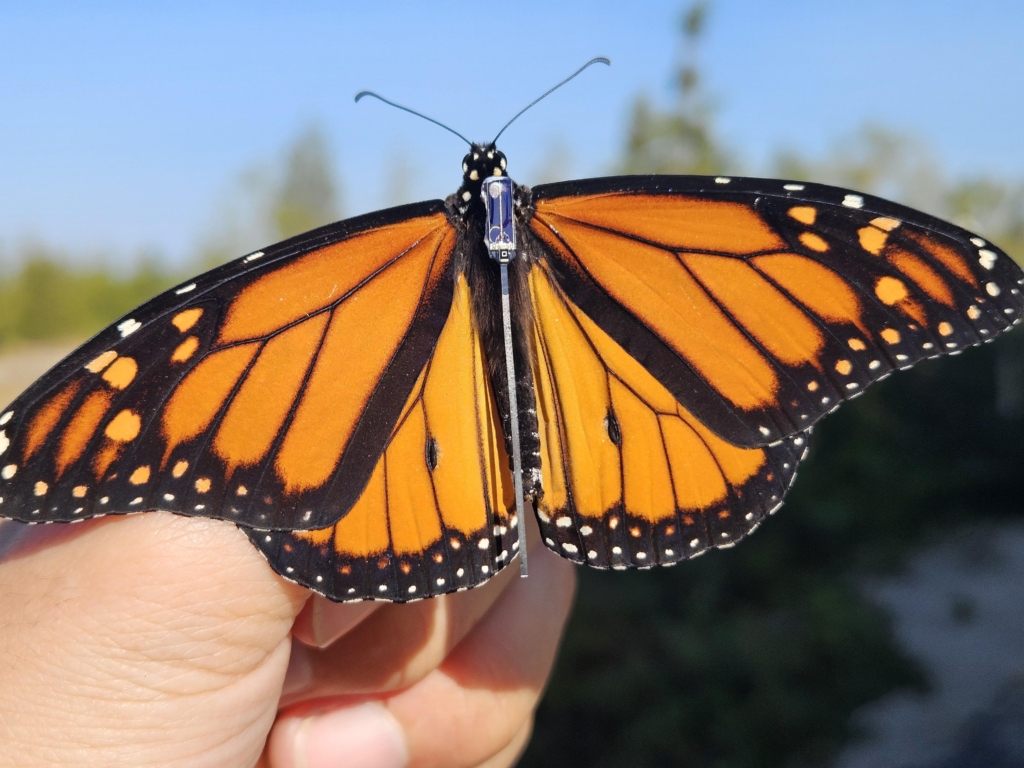
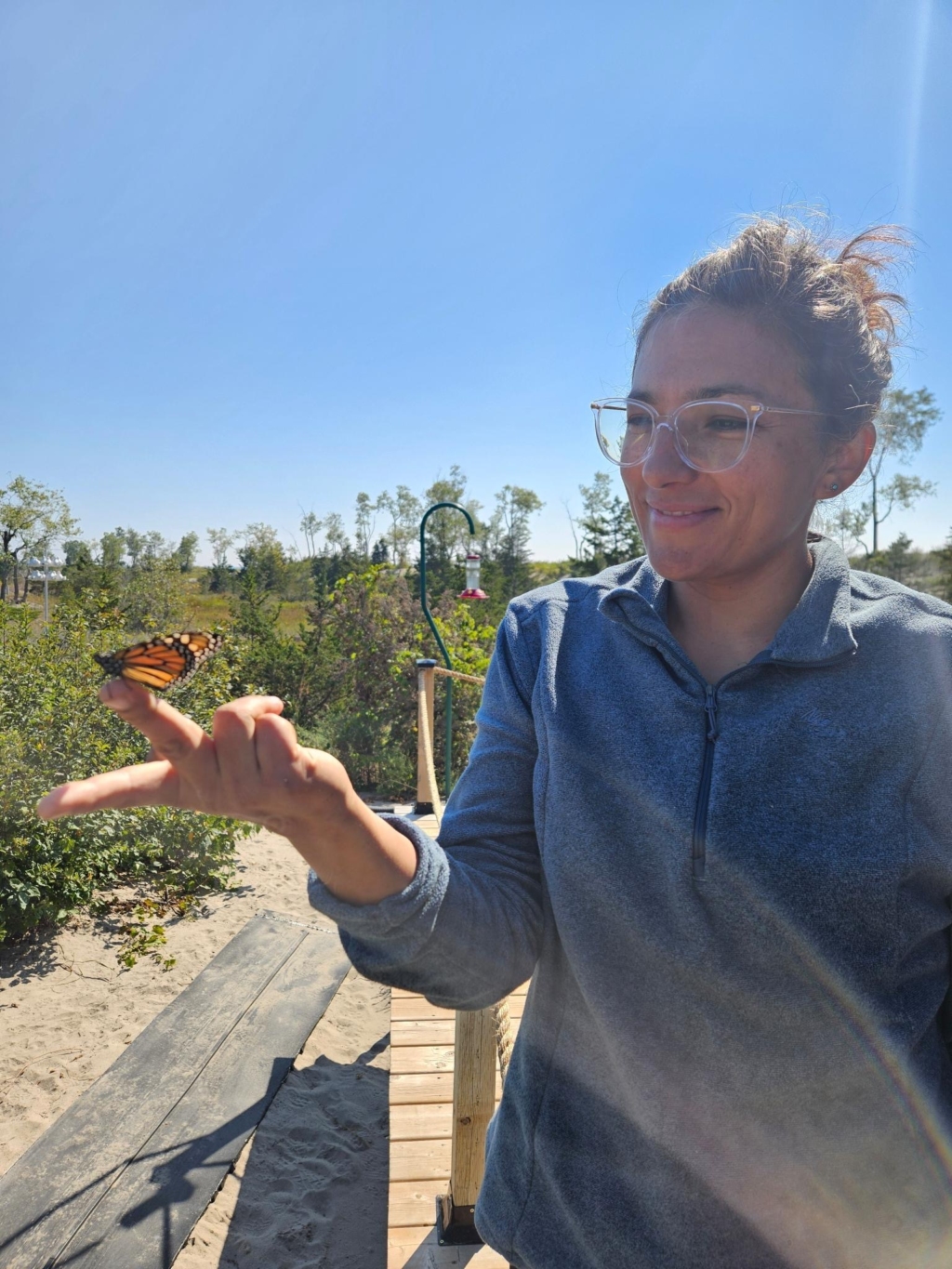
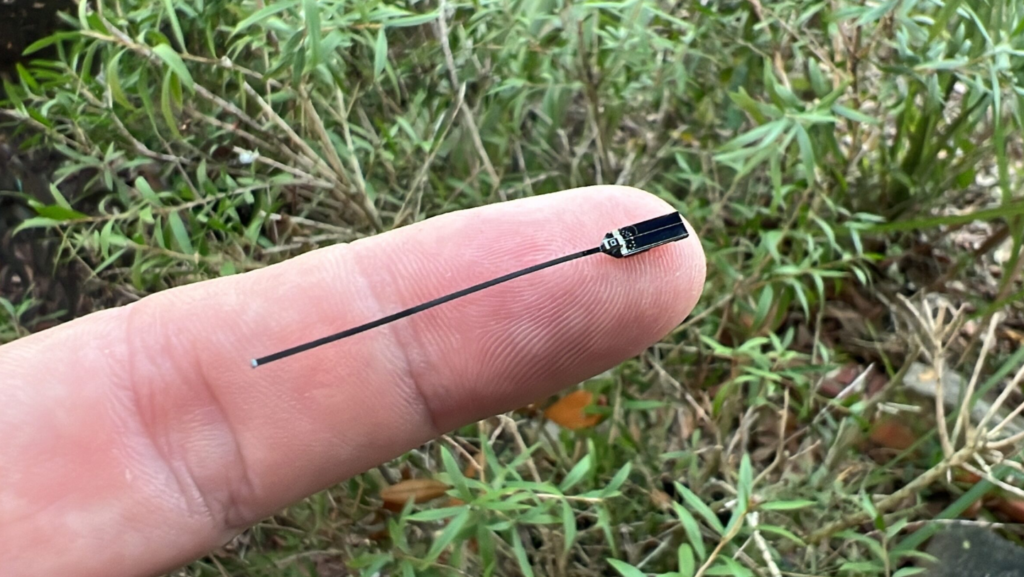
In early September, the team from ECCC, accompanied by graduate students Marianne Goulet (University of Guelph – working with Dr. Ryan Norris) and Lily Charles (University of Ottawa – working with Dr. Heather Kharouba) joined Birds Canada staff (LPBO and Motus) and volunteers at the Tip to conduct a follow up to 2024’s study, and deploy a first wave of 30 new enhanced BlūSeries+ tags. The addition of BlūSeries+ is a major advance for some applications: these devices can be detected by equipped Motus stations, as well as cell phones and Motus-compatible Terra stations, dramatically expanding detection possibilities across a wide range of landscapes. The results started to pour in almost immediately from stations, and mobile Motus stations (e.g., cell phones) from fishermen on boats, cottage-goers on the beach, and communities around Lake Erie and beyond.
The tracks collected during this period captured monarchs leaving the Tip of Long Point, crossing Lake Erie, and continuing southwest across both rural and urban regions—patterns that had previously been inferred from sightings and weather patterns, but never visualized with such precision. Nearly all of this initial wave of monarchs rapidly crossed Lake Erie arriving in Erie, Pennsylvania, or farther west toward Cleveland, Ohio. One butterfly disappeared off the Tip of Long Point only to be detected on Pelee Island three days later.
Following the success of this project, and similar initiatives at Cape May, New Jersey, CTT and the Cape May Point Arts & Science Center (CMPASC), monarch experts across North America rallied to deploy more than 500 tags across their range. This collaboration brought together more than 20 organizations across four countries, underscoring the level of coordination required for continent-wide insect tracking. Data from tagged monarchs can be tracked through the Project Monarch app, and data will soon be integrated for public exploration through the Motus database. As a part of this effort, Birds Canada and collaborators coordinated a second, larger wave of deployments, releasing 25 tagged monarchs at both Long Point (The Tip, Old Cut and Birds Canada Headquarters), and near Point Pelee.
Reflecting on the first detections from Long Point, Greg Mitchell noted that “When data started streaming in from our first deployment at Long Point, I knew it was a game-changer. The immediacy and impact of the results were astounding and made us all realize that we could start to truly understand how monarchs move through the landscape and respond to weather and navigational challenges they encounter across their entire migratory journey. Ultimately, this will help us understand how climate change may be impacting monarchs and provide an evidence base for how different habitats, e.g. protected areas and even gardens, are helping monarchs from Canada reach Mexico.” Greg also noted that “This work would have been very challenging without the support of Birds Canada and the Long Point Bird Observatory. Having like-minded and strong conservation partners is what made this project both possible and successful. It was truly a team effort.”