New Common Loon research uncovers a widespread decline and calls for action
The unprecedented international effort to understand and reverse declines in one of North America’s most iconic waterbirds.
Alberta has opened the door to new development in the heart of Canada’s Greater Sage-Grouse habitat. With an estimated 54 birds left in the entire province, the stakes could not be higher. The species is already extirpated from British Columbia, making Alberta’s remaining population all the more important. As industrial development continues to be at the forefront of national and provincial priorities, we must be careful to shape a future where economic development and protections for our most imperiled species can coexist. This is an achievable goal, supported by the knowledge and tools that already exist.
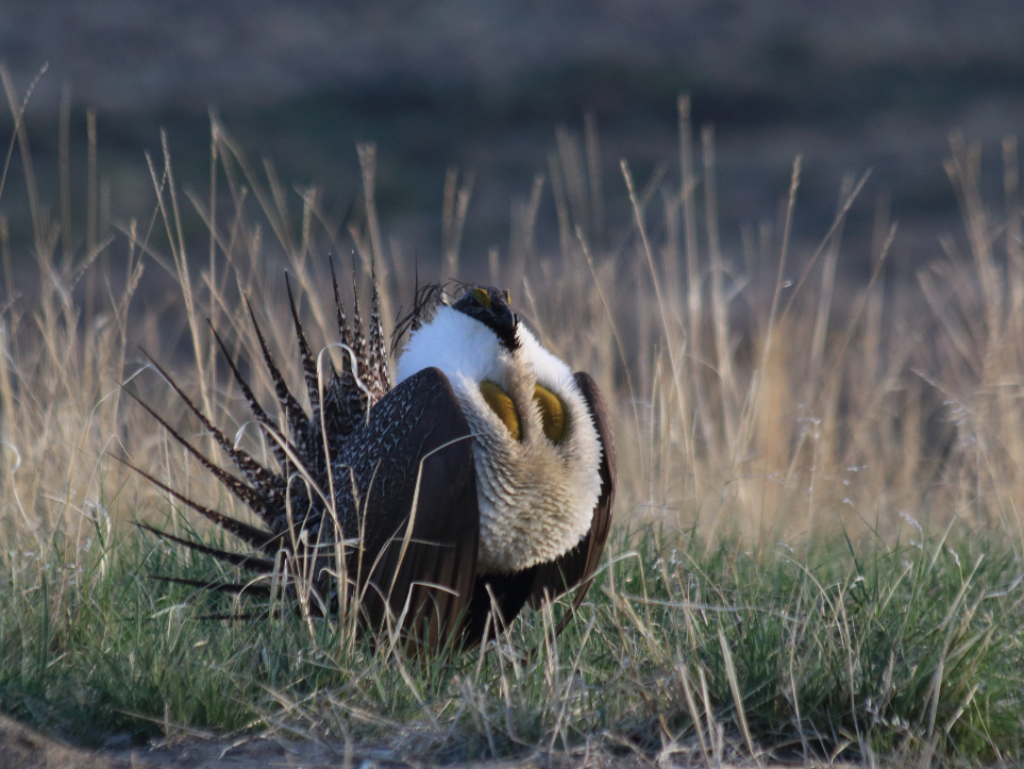
©Greater Sage-GrousePhoto: Sean Jenniskens
Just before the sun rises, when the land is still washed in darkness, the prairies wake with the chorus of birds; a Long-billed Curlew whistles through the sky, while Burrowing Owls scout the horizon from atop their burrows. But the most awe-inspiring of them all is the male Greater Sage-Grouse performing their dance in the hopes of attracting a mate. They fan their pointed tail feathers and puff up brilliant yellow air sacs on their chests to produce a popping, bubbling sound to attract females. This dancing ground is called a “lek”, and the gathering of males performing this flamboyant ritual is one of the most spectacular wildlife displays in Canada.
The Greater Sage-Grouse is the largest grouse in North America, earning its name from the sagebrush plants that they rely on for food and shelter year-round. The silver sagebrush grassland community located in southeastern Alberta and southwestern Saskatchewan provide the last remaining habitat for the Greater Sage-Grouse in Canada.
In both Alberta and Saskatchewan, Greater Sage-Grouse population declines of ~98% have been observed, similar to the ~80% long-term population declines recorded in the USA. Habitat loss and degradation, human disturbance, persistent and frequent severe weather events (e.g., droughts and extended periods of heavy rainfall), and disease (West Nile Virus) are some of the primary threats that have contributed to long-term population declines and continue to limit population recovery.
To address these threats, in 2014 the Government of Canada implemented an Emergency Protection Order which restricts human disturbances and development on 1,672 km2 of Greater Sage-Grouse habitat across Alberta and Saskatchewan.
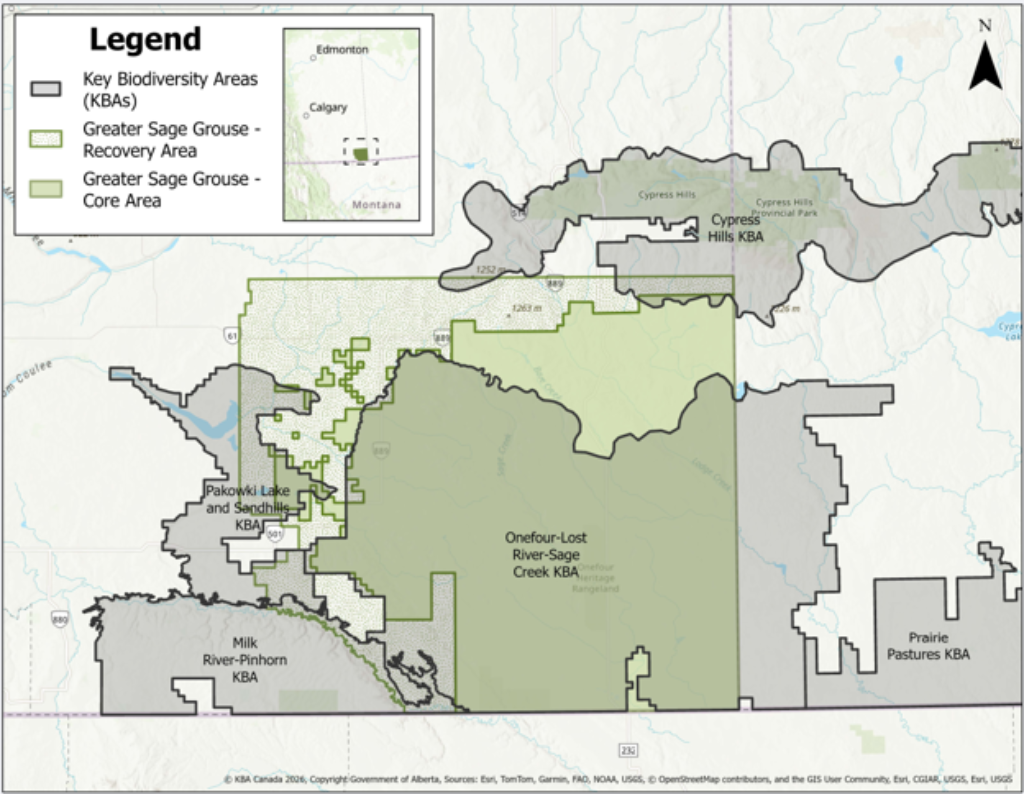
In 2021 the Government of Alberta established the Greater Sage-Grouse Recovery Area, which expanded protections across ~4,000 km2 in the southeastern corner of Alberta.
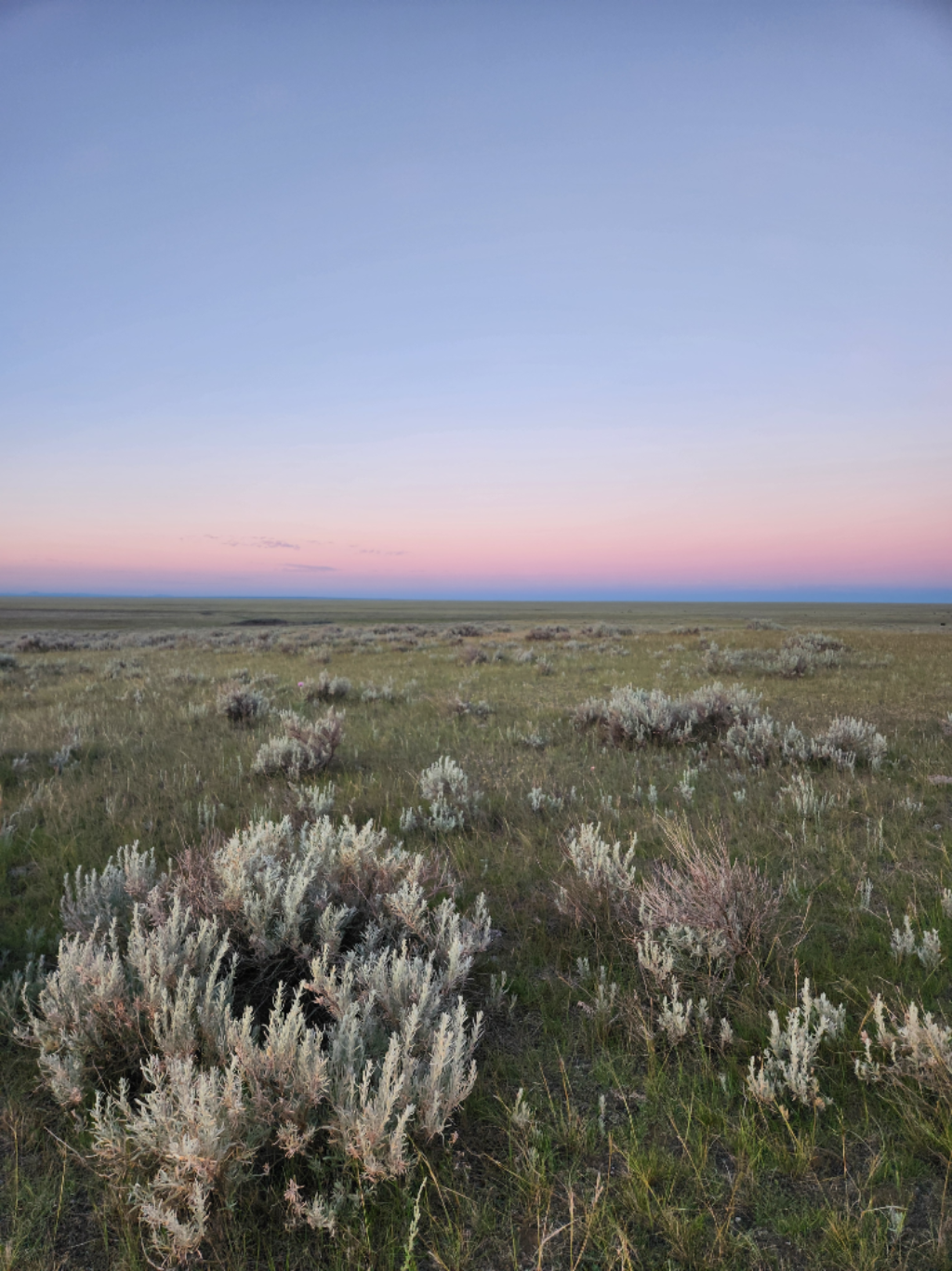
Photo: Natalie Vieira-Lomasney
In July 2026, the Government of Alberta quietly removed a suite of provincial protections within the Greater Sage-Grouse Recovery Area and within a month, approved the development of a new helium plant in the area. In Alberta, a Master Schedule of Standards and Conditions (MSSC) lists the guidelines and approval standards that are required for energy development on Alberta’s public lands. The MSSC was updated to remove specific conditions that provided safeguards for the Greater Sage-Grouse, including: 1) no development within 3,200 meters of leks (breeding grounds), 2) no removal of sagebrush plants, native grasses, and native forbs, 3) restrictions on noise levels, 4) restrictions on road developments, and many others.
These safeguards were not put in place arbitrarily. They reflect years of research, monitoring, and knowledge-sharing among scientists, conservation partners, rightsholders, land managers, and other stakeholders working to understand and address the threats facing the Greater Sage-Grouse. The impact of development, including the installation and presence of powerlines and infrastructure, noise, and habitat loss have well-known negative impacts on the Greater Sage-Grouse. These disturbances can cause abandonment of leks, reduce nest and brood survival rates, increase avoidance of developed areas year-round, and more.
Rather than remove the crucial safeguards that protect these birds, the Government of Alberta has an opportunity to use existing knowledge and partnerships to ensure species conservation and responsible development can go hand-in-hand.
The last remaining Greater Sage-Grouse in Canada are only found in Grasslands National Park in Saskatchewan, and in the southeastern corner of Alberta. These remnant grassland habitats are part of the most endangered ecosystem in Canada. Both areas are designated as Key Biodiversity Areas (KBA), recognizing their important contribution to the persistence of biodiversity.
In Alberta, the Onefour-Lost River-Sage Creek KBA, which includes the region of the approved helium development, supports more than 30% of the Canadian Greater Sage-Grouse population, alongside an incredible diversity of other species. This KBA is home to four other at-risk grassland birds, including the nationally Endangered Chestnut-collared Longspur, 10% of the Canadian Eastern Yellow-bellied Racer and Greater Short-horned Lizard populations, and 50% of the Canadian population of three unique moth species. It also provides habitat for the nationally Threatened Swift Fox and 5 at-risk plant species, including 99% of the remaining Soapweed, and 85% of the remaining Upland Evening-primrose, in Canada.
The Greater Sage-Grouse Recovery Area is the result of decades of collaborative research. It contains two rare ecosystem types and overlaps with three additional KBAs; Pakowki Lake, Milk River-Pinhorn, and Cypress Hills. These landscapes form an interconnected network of grassland ecosystems that support a wealth of Canadian biodiversity.
Ultimately, protecting the Greater Sage-Grouse means protecting so much more than one species. It’s an opportunity to bring together partners and decision makers from across provincial and international borders, to ensure a future that protects an entire ecosystem.
The removal of scientifically supported safeguards for the Greater Sage-Grouse is an example of natural resource development being prioritized over the protection of Alberta’s threatened species.
Here’s the reality: the protections are being removed because they are viewed as an obstacle to resource development in the area. Certain industries believe they will benefit by having fewer rules about where and how they can operate. The helium industry is just the first at the table – the Helium Developers Association of Canada has been lobbying both the Alberta and Canadian governments to support expanded helium development, particularly in Alberta and Saskatchewan – and they got the deal they wanted, with the door now opened to any new developments in some of Alberta’s most imperiled landscapes.
While the province carefully considers the interests of developers in pursuing new economic initiatives, they have not applied that same care and consideration to the wildlife that depend on these grassland habitats for survival. Helium potential exists across several regions of Alberta, including areas well outside of the grassland habitats in the southeast. Unlike helium, which occurs across a broad area, the Greater Sage-Grouse has very few remaining habitat options.
Long-term population recovery of the Greater Sage-Grouse and other grassland species is achievable. The scientific expertise and knowledge, conservation partnerships, and on-the-ground experience already exists in Alberta. For example, the Orphan Well Association has made incredible progress in successfully decommissioning and reclaiming a crude oil production network to support the recovery of the Greater Sage-Grouse and other grassland species. These types of reclamation efforts can increase the quality of habitat available to the Greater Sage-Grouse for nesting, and help restore healthy, functioning grassland ecosystems that can be sustained with thoughtful land management.
The Government of Alberta has publicly stated that they will continue to support “brood and nest-augmentation programs, habitat restoration, predator management, stewardship partnerships, and enhanced monitoring”. These are important initiatives with proven success. Now is the opportunity for the Government of Alberta to build on these promises with a funding commitment, timely action, long-term support and planning, and a reinstatement of protections.
Sustained investment and a shared commitment to the Greater Sage-Grouse can lead us to a future where Alberta’s grasslands and the species that rely on them can thrive.
Birds Canada believes that responsible economic development and biodiversity conservation must move forward together. We recommend the following actions to ensure that the Greater Sage-Grouse and countless other grassland species thrive on the Prairies:
Together we must support the local land stewards and communities that help maintain healthy grassland ecosystems. Birds Canada is continuing to advance the implementation and expansion of the Bird-Friendliness Index across the Canadian Prairies, while advocating for the programs listed in the Prairie Conservation Incentives Guide to support land stewards on the ground who can make a real difference in the lives of grassland birds.
The Canadian Parks and Wilderness Society (Southern Alberta Chapter) and the Alberta Wilderness Association (AWA) are playing a key role in highlighting the loss of protections for Greater Sage-Grouse, and continue to be at the forefront of this issue. We are working alongside these organizations and others to stand up for our most vulnerable species. You can add your voice to these efforts by joining AWAs letter writing campaign.
The Greater Sage-Grouse is one of our most at-risk birds, with ~54 individuals left in Alberta and ~200 left in Canada – if protections can be weakened for a species this close to disappearing, what does it mean for others in Canada? Our decisions today will impact how we protect nature tomorrow, and at Birds Canada we want a future where birds thrive in healthy habitats.
I've been grateful to work across diverse landscapes in North America with some of our most at-risk avian species, and have seen the positive impacts of effective collaboration that makes a difference for these wildlife and their habitats. Specifically, for my master’s degree, I assessed the efficacy of using Greater Sage-Grouse as an umbrella species and observed the influence of landscape-scale reclamation projects on sagebrush songbird communities. I believe strongly in evidence-based decision making and intentional partnerships, to ensure that we can all tackle complex conservation issues together. This is especially true in my work with Birds Canada, as I'm responsible for the scientific direction and delivery of research projects, monitoring, stewardship, outreach, and partnership development for our aerial insectivore programming in Ontario.
I am a science communicator with Birds Canada, with a degree in Renewable Resource Management from the University of Saskatchewan. I spent over five years working with at-risk Piping Plover, first in Saskatchewan and then in Ontario. I now live in Alberta, drawn here by the incredible landscapes found across the province. I work to highlight the conservation stories coming out of the Prairies, and host The Warblers podcast which engages people across Canada in a shared love of birds.
I'm a social scientist who has over a decade of experience working in the environmental sector. I am the Senior Director, Conservation Policy, and Atlantic Programs at Birds Canada where I support the delivery and management of all Atlantic programs and national conservation policy work, helping to develop Birds Canada's positions on emerging issues, and contributing to national discussions. I have a Master of Environmental Management and bring extensive experience in program management, environmental advocacy and policy, and Indigenous & community engagement.
Sign up for Birds Canada’s newsletter to receive the latest stories, science, conservation news, and opportunities to get involved.
The unprecedented international effort to understand and reverse declines in one of North America’s most iconic waterbirds.
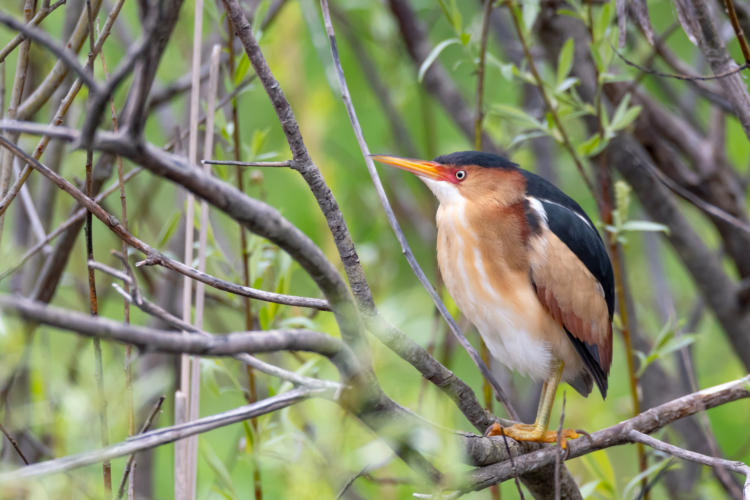
Birds Canada science has helped attract millions of dollars in recent funding to restore hundreds of hectares of threatened Great Lakes coastal wetlands for birds. Read on to see how data from our Great Lakes Marsh Monitoring Program and science-based recommendations from our Long Point Waterfowl and Wetlands Research Program have been critical for making this happen.
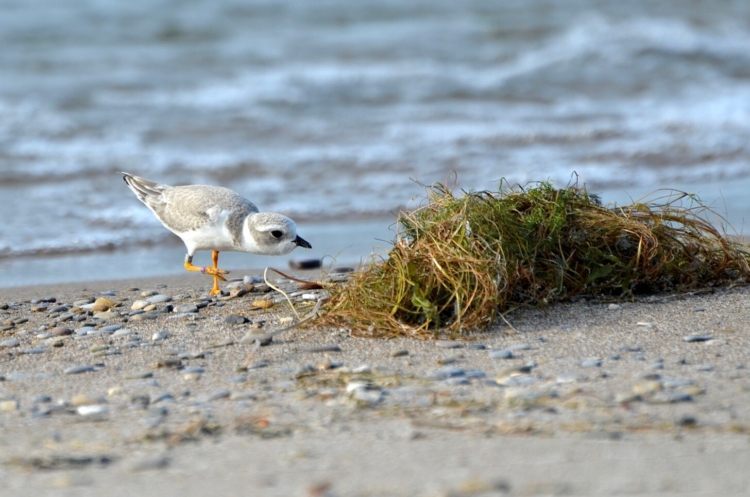
More than a century of conservation efforts paid off this spring, when a pair of Piping Plovers established a nest at Long Point for the first time since 1977. For nearly 50 years, birders, scientists, and nature lovers have eagerly awaited the return of nesting Piping Plovers to the Canadian shores of Lake Erie. Read on to learn just how significant this return is, and why it gives us hope for the future.