Skip to content

New Common Loon research uncovers a widespread decline and calls for action

The unprecedented international effort to understand and reverse declines in one of North America’s most iconic waterbirds.

10-minute read 

By Dr. Doug Tozer, Director, Waterbirds & Wetlands; Dr. Matthew Fuirst, Research Ecologist and Observatory Manager; and Kathy Jones, Volunteer Manager 

Anyone who spends summer days on northern lakes is familiar with the beautiful and haunting calls of Common Loons. Watching or listening to these iconic waterbirds is a cherished part of quality time by the water for many outdoor enthusiasts. However, the famous melancholic wail of the Common Loon might now be a call for help. Unfortunately, populations of this immensely popular species are now declining across North America. A new, revealing study by Birds Canada and numerous collaborators used data collected by thousands of passionate volunteers to shed light on the outlook for Common Loons. Despite an uncertain future for the species, there is hope: there are actions we can all take now to help Common Loons that we know are effective, and Birds Canada and our collaborators are working hard to identify other actions to help curb population declines.  

What we know 

Data collected by thousands of volunteers in Birds Canada’s extremely popular Canadian Lakes Loon Survey (over 4,000 volunteers have participated to date!) show that Common Loons have raised fewer chicks each year over the past several decades (a, b). In addition, data from the Breeding Bird Survey, conveniently summarized for the Common Loon in The State of Canada’s Birds (a partnership project between Birds Canada and Environment and Climate Change Canada), showed that the number of adult Common Loons has decreased over the past decade throughout most regions of southern Canada. Declines in chick production and adults have also occurred in some parts of the U.S. 

Canada holds a great responsibility for the Common Loon, seeing as 94% of the world’s ~254,000 breeding pairs reside in Canada. So, to figure out why Common Loons are declining, and what can be done about it, Birds Canada co-founded the Loon and Diver Research Working Group in 2021. This international network of over 30 loon researchers across U.S. and Canada are working to identify the factors responsible for changes in Common Loon populations. The group has considered dozens of factors, including human disturbance, shoreline development, competition with other bird species, pollution, and disease. The current hypothesis favoured by the group is that the declines are being caused by decreasing lake water clarity. As extreme precipitation events get more common due to climate change, more sediment and organic matter washes into lakes making the water cloudier and more difficult for diving loons to see their underwater prey. The idea is that murkier water over the years means adult loons have a harder time finding and catching fish to feed to their chicks, and as a result fewer chicks survive over time. Plus, the chicks that do survive end up in poorer condition (lower mass) because they receive less food from their parents, which means they have a lower chance of surviving through to adulthood. 

In 2024 scientists from Chapman University, California, revealed that decreases in water clarity over the past several decades on Common Loon nesting lakes in northern Wisconsin appeared to be responsible for the decline in chicks and adults observed in the region over the same time period.
New science and what it tells us 

The next piece in the loon puzzle was to establish if, and by how much, Common Loon chick production has decreased throughout the species’ North American range. We knew that chick production had been decreasing in some regions, but we didn’t have a clear picture of whether these patterns extend throughout the southern extent of the Common Loon breeding range. Knowing this information and bringing it all together in one place would help pinpoint the cause or causes behind the declines—an important step to develop solutions to mitigate or eliminate them. So, Birds Canada, in partnership with numerous collaborators, spearheaded a large collaborative investigation of patterns and trends in Common Loon chick production throughout most of the species’ breeding range across North America. Our new groundbreaking study was based on data from 45,000 Common Loon breeding attempts spanning 49 years (1975–2023) on 3,400 lakes in 9 Canadian provinces and 7 U.S. states. In addition to Canadian Lakes Loon Survey data collected by Birds Canada volunteers, nine collaborating organizations generously contributed large, long-term datasets, many of them also collected by volunteers, making it the largest Common Loon analysis of its kind ever undertaken (please see list of contributing organizations below). 

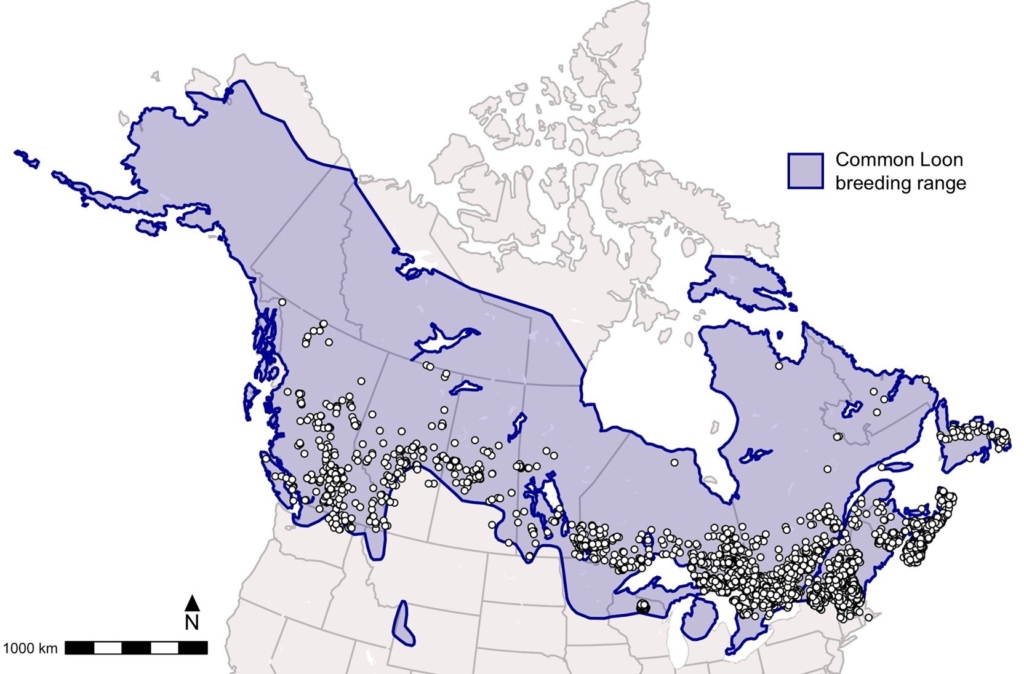
a. Map of the Common Loon breeding range (blue) and the 3,421 lakes surveyed (white dots) by volunteers and researchers throughout the 12 regions that monitored Common Loons in the U.S. and Canada (white dots) for the study published by Fuirst et al. 2026.

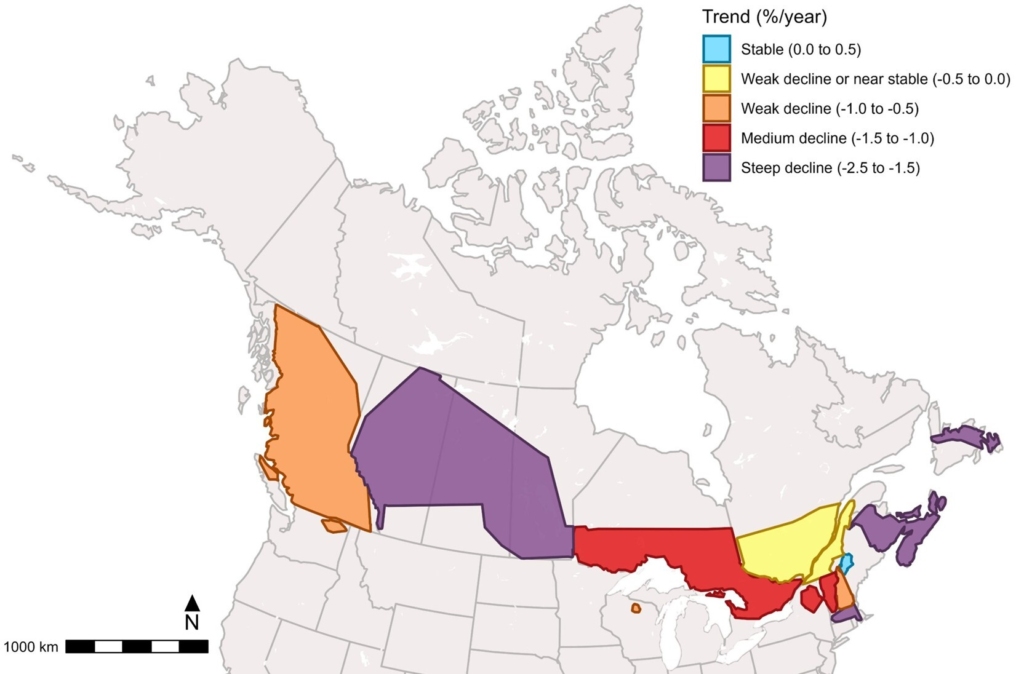
The results of the study are sobering. Common Loon chick production declined by a total of ~40% on average over the decades in 10 out of the 12 regions analyzed, with the total decline ranging from 14 to 74% over the years depending on the region and time period. Long-term declines were present in British Columbia, the Prairie provinces, Ontario, the Atlantic provinces, Washington, Wisconsin, New York, Vermont, New Hampshire, and Massachusetts. Only in Québec and Maine was chick production relatively stable or slightly increasing. The study’s main conclusion: chick production has decreased substantially over the past several decades throughout most of the monitored portions of the Common Loon’s breeding range. 

b. Map of trends in Common Loon productivity calculated from an analysis from Fuirst et al. 2026 for Prairie provinces (Alberta, Manitoba, and Saskatchewan combined), Atlantic provinces (New Brunswick, Newfoundland and Labrador, and Nova Scotia combined), British Columbia, Ontario, Quebec, Maine, New York, New Hampshire, Vermont, Massachusetts, Wisconsin, and Washington. Trend values are categorized as steep declines (-2.5 to -1.5% per year), medium decline (-1.5 to -1.0% per year), weak decline (-1.0 to -0.5% per year), weak decline or near stable (-0.5 to 0.0% per year) and stable or increasing (0.0 to 0.5% per year). 

Next steps 

With the full picture across most of the breeding range now in hand, it is an opportune time to identify the factors behind the declines. So, let’s go back to what is already known: decreasing water clarity appears to be the reason for declines, at least in Wisconsin. Fortunately, by using data derived from satellite imagery, a measure of water clarity can be calculated for thousands of lakes over many different years, which can then be related directly to chick production on the same lakes in the same years. Birds Canada is now investigating whether widespread declines in chick production can be explained by changes in lake water clarity across the southern extent of the Common Loon breeding range. This follow-up study will help determine if the link between chick production and lake water clarity extends throughout most of the breeding range, rather than only within northern Wisconsin as described above. By identifying widespread causes of Common Loon decline we hope to identify and promote effective solutions that will stabilize or increase Common Loon populations throughout the species’ breeding range. 

In the meantime, despite all the negative data, all is not lost: some lakes still have high loon chick production and one reason for this is the care and management local volunteers provide to Common Loons and loon nests in their area—so thank you very much for your loon conservation efforts. Plus, there are actions we can all take now to help Common Loons. 

How you can help 

  • Donate to Birds Canada here, so we can make even more progress on conserving Common Loons 
  • Participate in Birds Canada’s Canadian Lakes Loons Survey, or any of the Common Loon monitoring programs in the U.S. (please see list of contributing organizations with potential opportunities below) 
  • Use non-toxic lead-free fishing tackle; all it takes is one sinker or jig to kill an adult loon, and ingestion of toxic tackle is the leading cause of death in adult Common Loons 
  • Dispose of fishing line and other plastics responsibly; many loons become fatally entangled in line and other debris left in lakes 
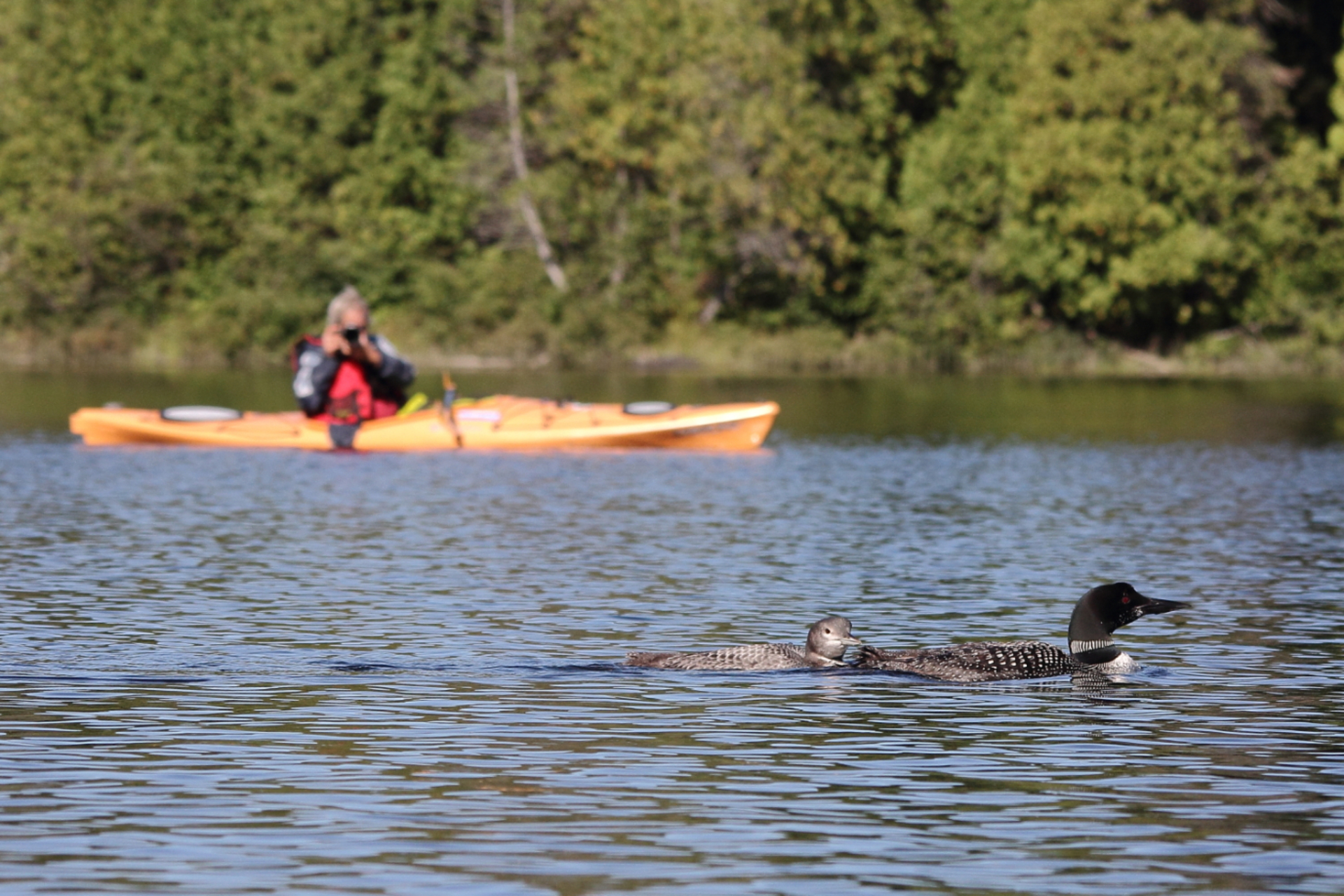
  • Slow down and steer clear of loons while you’re out on the water; loons may not be able to escape your path and if you separate adults from their chicks, they can’t protect them from predators  
  • Visit the Canadian Lakes Loon Survey project resources page on NatureCounts for more ways to help loons 
  • Your voice makes a difference, so please speak up and send a powerful message to your community and network for conserving Common Loons and their habitats 
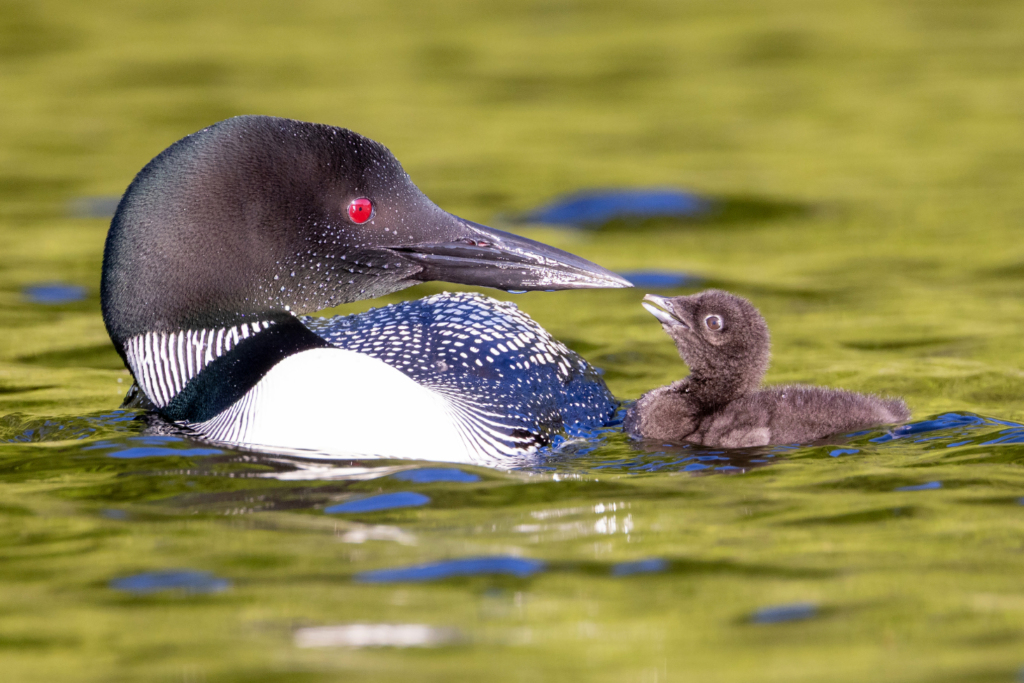
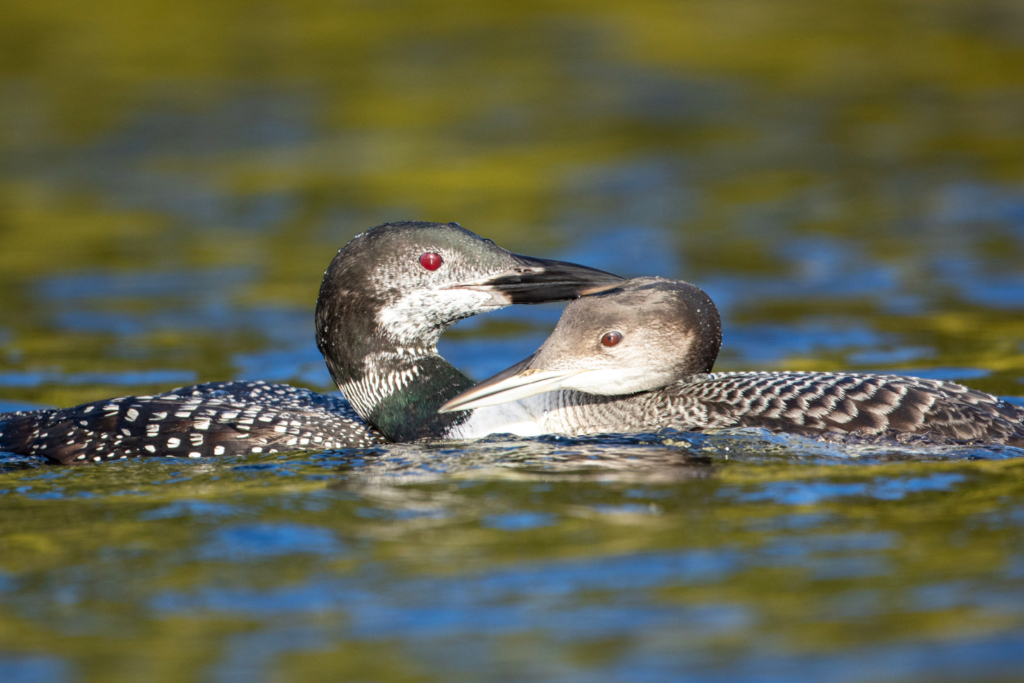
A Common Loon touching bills with its chick.

Learn more in our episode of the Warblers


A big thank you 

We simply could not have accomplished this without the valued effort of thousands of volunteer surveyors, so thank you very much to each of you for your dedicated support of, and participation in, the Canadian Lakes Loon Survey, Breeding Bird Survey, and the many other Common Loon monitoring and conservation programs that contributed data to our study. We’re also extremely grateful to 20 wonderful co-authors who worked hard to make our research a resounding success, as well as for coming together to deliver a strong unified statement on the status of Common Loons. Birds Canada’s Canadian Lakes Loon Survey is delivered in partnership with QuébecOiseaux, for which we are very grateful. Birds Canada’s loon science and conservation work has also benefited immensely from financial support, for which the following have been essential: Hodgson Family Foundation; National Loon Center & Ricketts Conservation Foundation; and private donors. 

Contributing organizations 

Director, Waterbirds and Wetlands
Dr. Doug Tozer

I’ve been hooked on birds ever since I can remember. For example, as a kid I got (a bit) annoyed when my family went on holidays to Disney World, because it meant I missed Canada Jay nest-finding with my Dad for a research project in Algonquin Park. Naturally, my academic and professional career has focused on developing workable conservation solutions for birds, and raising awareness of the importance of these animals. Currently, I work on waterbirds and wetlands by directing the Great Lakes Marsh Monitoring Program, Canadian Lakes Loon Survey, and Long Point Waterfowl and Wetlands Research Program.

Research Ecologist and Observatory Manager
Matthew Fuirst, Ph.D.

I've been drawn to wildlife biology since I was a kid spending hours investigating insects along streams and reading about birds and mammals. It was not until my undergraduate career (with the help of a close friend) that I became hooked on birding and field ornithology. I have broad interests in understanding the demography and movement ecology of wild animals, with particular research strengths in spatial modelling, avian monitoring and conservation, behavioural ecology, and molecular analyses. I received my MSc from Stony Brook University (in New York), where I studied the foraging and microbial ecology of Herring Gulls. I was awarded a Ph.D. from the University of Guelph where my studies examined the role of dispersal in population dynamics of adult and juvenile Canada Jays in Algonquin Park. Currently, I am responsible for Long Point and Thunder Cape bird observatories, and aspects of the Canadian Migration Monitoring Network, and I am using data from the Canadian Lakes Loon Survey to understand survivorship and contaminants of Common Loons.

Volunteer Manager and Biologist, Ontario Programs, Canadian Lakes Loon Survey & Great Lakes Marsh Monitoring Program
Kathy Jones

I am an avid supporter of conservation, habitat stewardship, and biodiversity, in the strength of grassroots community actions, and that each individual can make a difference. I spent my childhood in Long Point, Ontario next to the Big Creek National Wildlife Area. There I formed a great love for boating, wetlands, wildlife, and all things aquatic. I hold an H.B.Sc. in Wildlife Ecology and Environmental Studies from the University of Guelph, a M.Sc.F in Wildlife Management from Lakehead University and Volunteer Management accreditation from Humber College. Past work in tourism, retail, raptor and duck research and data management as well as experience collaborating with Citizen Scientists has led me to my present job. My three beautiful and almost adult children have taught me that yes, your beliefs can be instilled in the next generation and that this is hope for our future.


Stay Connected with Birds Canada

Sign up for Birds Canada’s newsletter to receive the latest stories, science, conservation news, and opportunities to get involved.

Discover More Articles Like This

All Articles
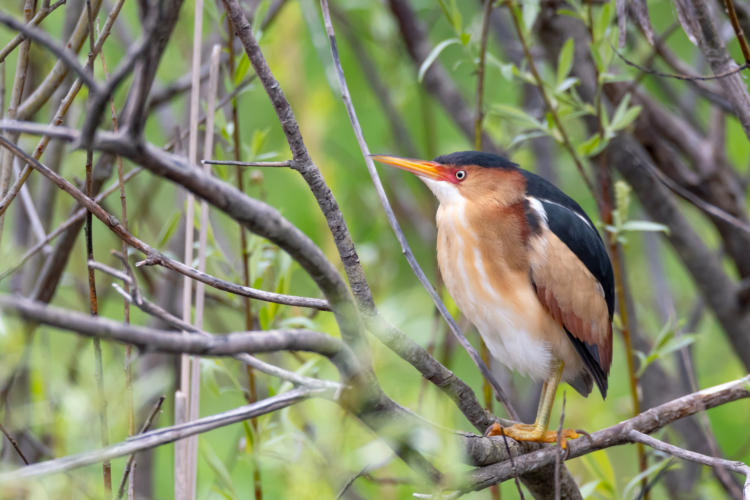
A Least Bittern perched in a tree
October 9, 2026

Birds Canada Science Critical for Great Lakes Coastal Wetland Bird Conservation

Birds Canada science has helped attract millions of dollars in recent funding to restore hundreds of hectares of threatened Great Lakes coastal wetlands for birds. Read on to see how data from our Great Lakes Marsh Monitoring Program and science-based recommendations from our Long Point Waterfowl and Wetlands Research Program have been critical for making this happen. 

A Piping Plover forages on a rocky beach
October 6, 2026

A homecoming for Piping Plovers on Lake Erie – nearly 50 years in the making

More than a century of conservation efforts paid off this spring, when a pair of Piping Plovers established a nest at Long Point for the first time since 1977. For nearly 50 years, birders, scientists, and nature lovers have eagerly awaited the return of nesting Piping Plovers to the Canadian shores of Lake Erie. Read on to learn just how significant this return is, and why it gives us hope for the future.

A workshop participant observes a bird banding demonstration.
July 21, 2026

A Relationship Taking Flight: Timiskaming First Nation

Strong partnerships are at the heart of effective bird conservation, and the growing relationship between Timiskaming First Nation (TFN) and Birds Canada embodies that spirit.