By Heather Polowyk, Aerial Insectivore Conservation Biologist (Atlantic Region)
Spring is in the air and so are the birds! Bank Swallows are making their way from South America to Canada to breed. This time of year, we have mixed feelings of excitement and nerves as we plan for another monitoring season.
The Atlantic Canada Bank Swallow monitoring project, led by Birds Canada, saw a successful 2025 season. We monitored 664 km of nesting habitat across the four Atlantic provinces, counting over 5,500 Bank Swallows and 16,000 burrows from 386 colonies.
The importance of landscape mosaics
Bank Swallows use diverse habitats for nesting, but they all have a common theme: near-vertical slopes of diggable soils or sands. This is so they can dig their 60-90 cm long burrows, where they build a nest at the end for their eggs. Their nesting habitat can be found along coastal cliffs, sand dunes, streams, rivers, lakes, and even aggregate pits and quarries.
Bank Swallows roost overnight in wetlands. In Nova Scotia alone, there are over 35,000 freshwater wetlands. These wetlands and other insect-supporting habitats, like agricultural lands, are also foraging habitats for Bank Swallows.
Between their many potential breeding habitats, and the vast array of roosting and foraging habitat – plus the fact that breeding Bank Swallows will fly up to 35 km from their nesting colony to roost and forage – means that Bank Swallows can be challenging to find!
While we have an idea of what habitats Bank Swallows prefer, we do not know the fine details. Why did they choose to nest here and not there? What plants do they prefer for wetland roosts? Do they have a wetland size preference? What areas are they using the most? These are the questions we are working to answer.

Photo: Heather Polowyk
Birds of a feather
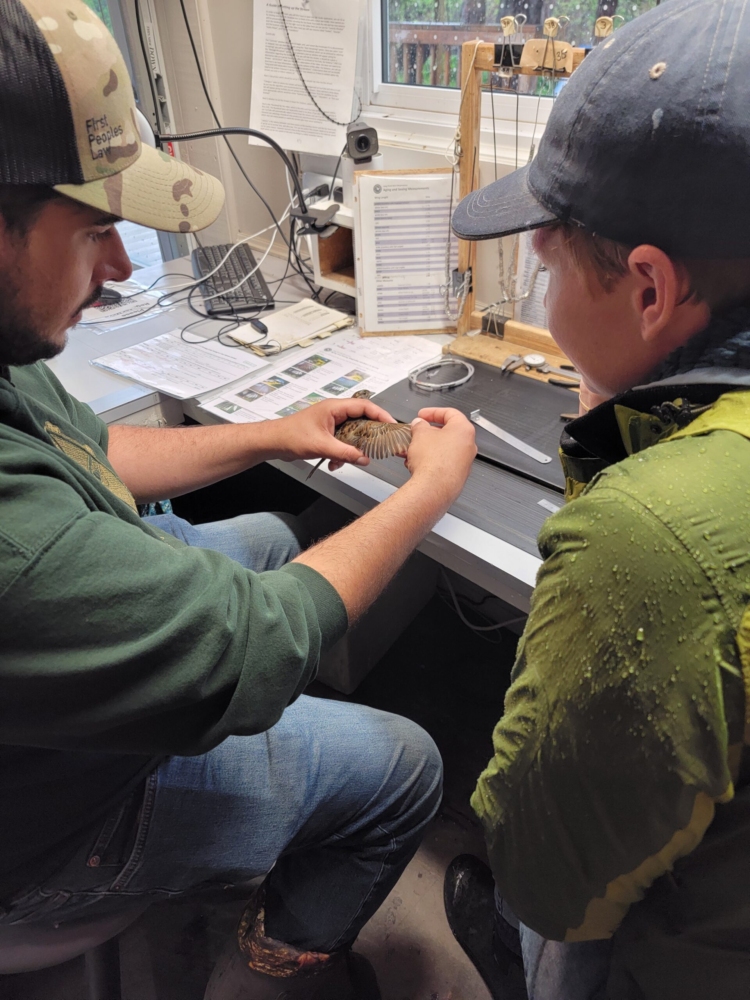
Monitoring Bank Swallow breeding populations across the four Atlantic provinces is no easy task, and we don’t do it alone! Collaboration, conservation planning, and sharing knowledge — all play an important role for Bank Swallow conservation. This is where the Atlantic Canada Bank Swallow Working Group comes in.
Since 2021, The Atlantic Canada Bank Swallow Working Group, led by Birds Canada, has brought together over 40 caring collaborators — Indigenous communities and organizations, environmental non-profit organizations, government departments and volunteers. We came together with a shared goal and a vision of communities working together in the pursuit of Bank Swallow conservation.

Photo: Robert Shortall
Bank Swallow-filled skies
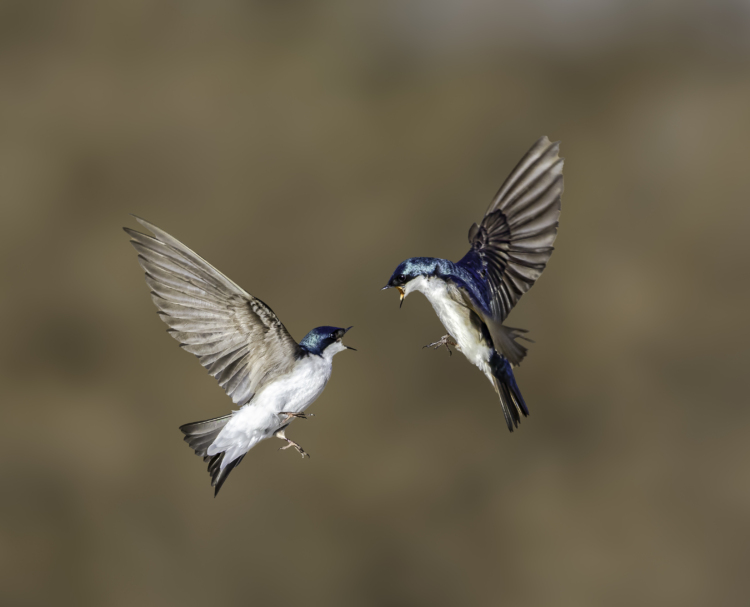
Compared to other birds, Bank Swallows are somewhat subtle with brown upper parts, white underparts, and a bold brown band across the chest. Bank Swallows are part of a group of birds called aerial insectivores, or birds that eat insects while flying. This group includes swifts, swallows, nightjars and flycatchers. Aerial insectivores have declined by 43% across Canada since 1970.
Bank Swallows are listed as Threatened across Canada under the federal Species at Risk Act. This status is due to our Canadian population dropping by 95% since 1970. The causes of this decline include habitat loss, climate change, and a global loss of insects. So, like banks, these birds are worth investing in.

Photo: Yousif Attia
Investing in banks
Together, we have been monitoring Bank Swallow nesting habitat using our route monitoring protocol since 2023. Routes range from 100 m up to 10 km along any potential nesting habitat. For some, this looks like a walk on the beach, eyes towards the sandy, coastal cliffs, looking for swooping Bank Swallows and the dark circles of their burrow entrances. For others, this looks like driving down old bumpy roads, and walking below steep soil piles to take note of how many meters of soil or sand is available as potential nesting habitat.
When Bank Swallows and/or their burrows are seen, we count them! If there is 50 m of potential habitat between burrows, we consider it a new colony. A monitoring route can have no colonies or several. This is because erosion – happening constantly at varying levels – plays an important role in their nesting habitat. Big storms can cause suitable nesting habitat to become unsuitable over the course of a day, a month, a year. Our protocol is designed to track these habitat changes and track Bank Swallow colony movements over time.
New in 2025, we created a Bank Swallow roost monitoring protocol. Using people power or autonomous recording units (ARUs), we are locating wetlands within 35 km of breeding colonies to listen and look for Bank Swallows at dusk and dawn. So far, we have monitored 12 wetlands and heard Bank Swallows at four of them. At each wetland, we are taking notes on vegetation, amount of open water, and other habitat characteristics to better understand what makes a good roosting wetland in the eyes of a Bank Swallow.

Photo: Robert Shortall
Investing in banks
Together, we have been monitoring Bank Swallow nesting habitat using our route monitoring protocol since 2023. Routes range from 100 m up to 10 km along any potential nesting habitat. For some, this looks like a walk on the beach, eyes towards the sandy, coastal cliffs, looking for swooping Bank Swallows and the dark circles of their burrow entrances. For others, this looks like driving down old bumpy roads, and walking below steep soil piles to take note of how many meters of soil or sand is available as potential nesting habitat.
When Bank Swallows and/or their burrows are seen, we count them! If there is 50 m of potential habitat between burrows, we consider it a new colony. A monitoring route can have no colonies or several. This is because erosion – happening constantly at varying levels – plays an important role in their nesting habitat. Big storms can cause suitable nesting habitat to become unsuitable over the course of a day, a month, a year. Our protocol is designed to track these habitat changes and track Bank Swallow colony movements over time.
New in 2025, we created a Bank Swallow roost monitoring protocol. Using people power or autonomous recording units (ARUs), we are locating wetlands within 35 km of breeding colonies to listen and look for Bank Swallows at dusk and dawn. So far, we have monitored 12 wetlands and heard Bank Swallows at four of them. At each wetland, we are taking notes on vegetation, amount of open water, and other habitat characteristics to better understand what makes a good roosting wetland in the eyes of a Bank Swallow.